Fraud Is Not Just a Control Failure: Integrity Under Pressure
Editorial: (Fraud Examination)
"Fathoming Fraud: Unveiling Theories, Investigating Pathways and Combating Fraud."
In this editorial, I argue that fraud should not be understood merely as a failure of controls, procedures or oversight, but as a pressured ethical decision shaped by organisational conditions, personal integrity, opportunity, capability and culture.
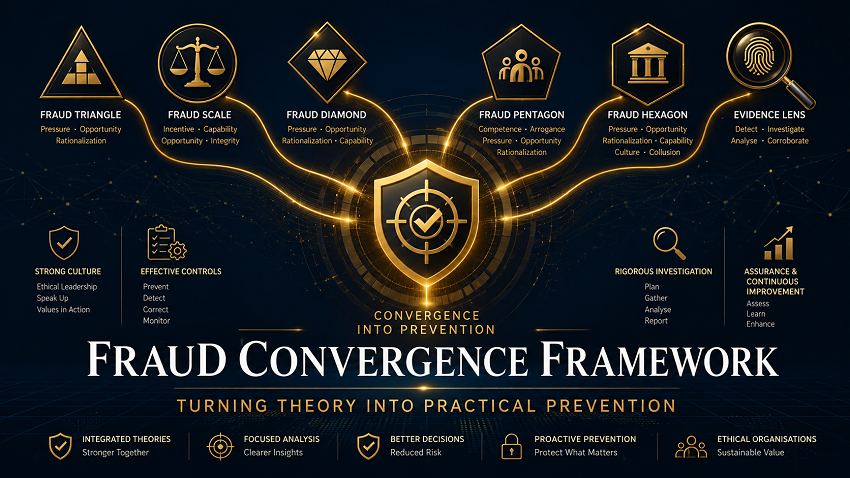
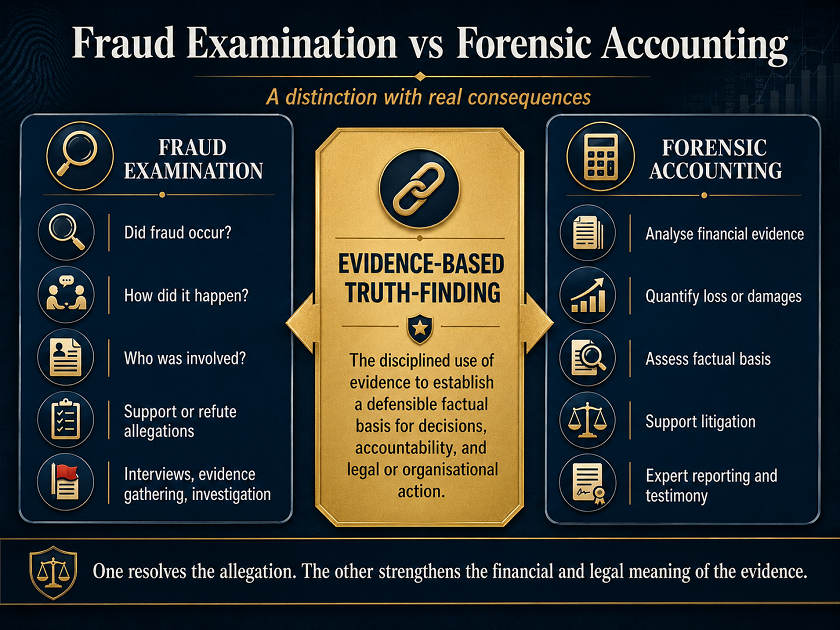
Mandal and Amilan (2021) contrast established fraud theories, including the fraud triangle, fraud scale, fraud diamond, fraud pentagon, MICE, SCCORE, organisational fraud models, and the triangle of fraud action, to show that financially motivated crime emerges through a pathway in which vulnerability becomes action. Their analysis highlights integrity as a practical fraud-risk factor rather than a soft moral ideal, while also distinguishing between fraud prevention and fraud investigation. It argues that controls may reduce opportunity, but culture shapes rationalisation, capability enables execution, and disciplined evidence-based truth-finding is required when prevention fails.
The golden thread is not "control failure" but "choice under enabling conditions".
Fraud happens when a person under pressure encounters opportunity, possesses or obtains the means to act, finds a way to justify the conduct, and operates in an environment that fails to stop, expose or morally disrupt the decision. What connects the theories is the search for the fraud pathway. In contrast, what separates them is the location of blame: inside the person, inside the organisation, inside the opportunity structure, or inside the evidence trail.
The central conclusion is that fraud is not just a control failure; it is a breakdown in ethical choice under pressure, made possible by enabling environments and exposed only through rigorous investigation.
Source:
Mandal, A., & Amilan, S. (2024). Fathoming fraud: unveiling theories, investigating pathways and combating fraud. Journal of Financial Crime, 31(5), 1106-1125. https://doi.org/10.1108/JFC-06-2023-0153
Image: OpenAI. (2026). Fraud Theories: The Golden Thread [AI-generated User-Prompted image]. ChatGPT.
Expanded Version: Read an expanded version of the Blog on
LinkedIn.